Market Pulse: March 2026
In this article (9)
Market Pulse: March 2026
Kansas City’s housing market accelerated into the spring season with strength across nearly every metric. Prices pushed higher, closings surged, and buyer demand remained active even as inventory growth began to level off. March is often a signal of what is ahead, and this year’s data points to a competitive and active spring market.
Strong upward movement
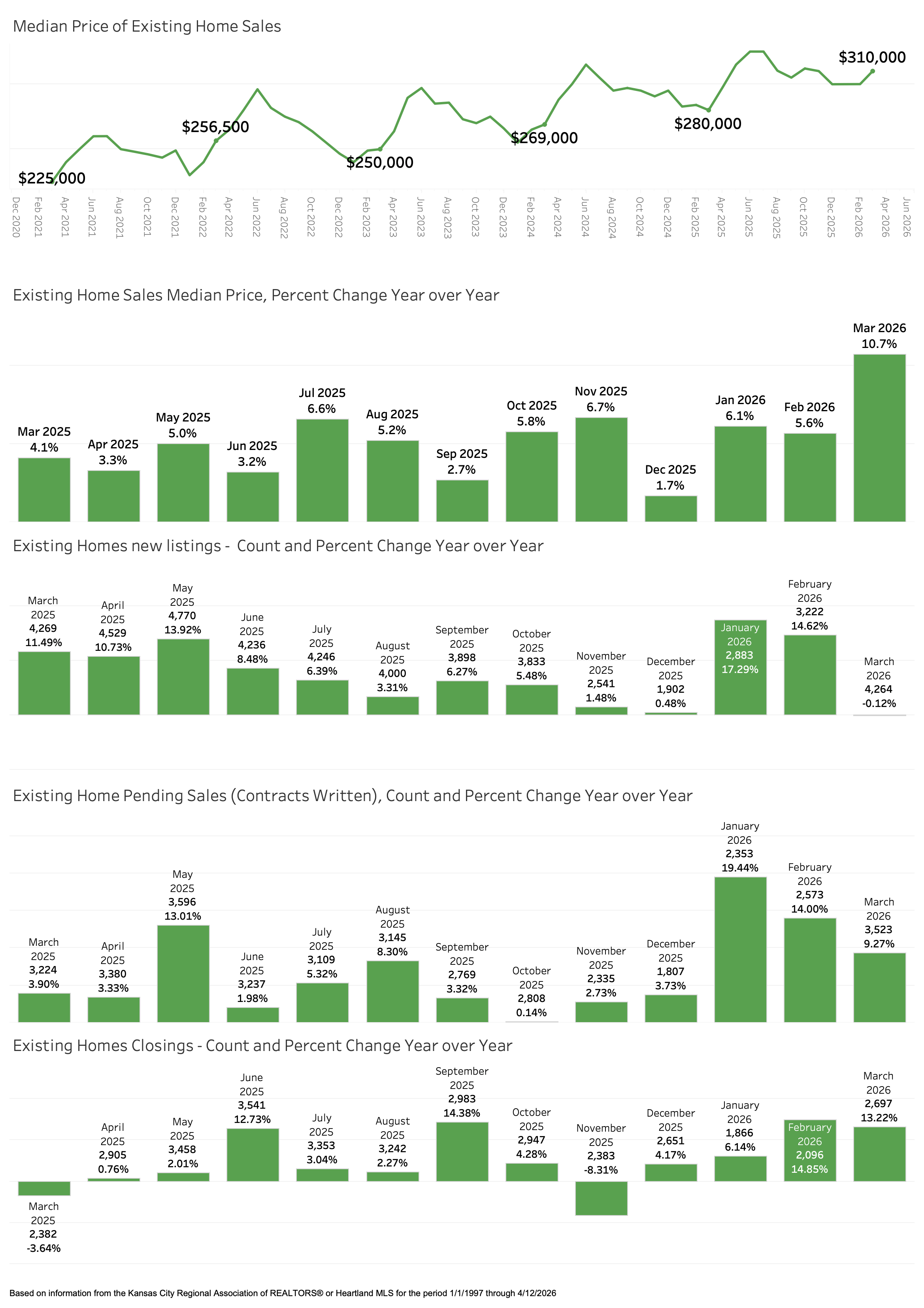
Median resale price: $310,000
Year over year: +10.7%
Price growth expanded meaningfully in March, reaching the strongest year over year gain we have seen in several months. The move to a $310,000 median reflects both continued demand and a market that is absorbing available inventory efficiently.
New Listings: Leveling after early surge
New listings: 4,264
Year over year: −0.12%
After strong increases in January and February, new listing activity flattened in March. While overall inventory is still improved compared to last year, the pace of new supply entering the market has stabilized, keeping conditions relatively tight as we move deeper into spring.
Demand: Momentum continues
Contracts written (pendings): 3,523 (+9.27% YoY)
Closings: 2,697 (+13.22% YoY)
Buyer activity remained solid in March. Pending contracts continued to outperform last year, and closings jumped more than 13 percent, reflecting strong pipeline conversion from earlier in the year. Demand is clearly present, particularly for well priced and well presented homes.
What this means for you
Sellers
The spring market is here, and buyers are active.
Pricing and preparation still matter, but strong demand is supporting successful launches.
Homes that show well are moving with confidence in this environment.
Buyers
Competition is increasing as we move into peak season.
Inventory is better than last year, but demand is keeping pace.
Preparation and speed remain key advantages in securing the right home.
Everyone
Kansas City is entering the heart of the spring market with strong fundamentals. Prices are rising, demand is active, and inventory has improved but not enough to shift leverage dramatically. This remains a balanced but competitive environment.
Headwinds: Rates, energy, and global uncertainty
While the data shows strong momentum, there are clear headwinds developing beneath the surface.
Mortgage rates moved sharply higher in March, climbing above 6.6 percent after briefly dipping below 6 briefly earlier in the year. This increase was driven largely by rising Treasury yields and inflation concerns tied to global events.
A major driver behind this shift has been the ongoing conflict involving Iran. The war has pushed oil prices higher, which feeds directly into inflation and, in turn, puts upward pressure on interest rates. Mortgage rates tend to follow the 10 year Treasury, and as those yields rise, borrowing costs increase for buyers.
Higher energy costs are also beginning to impact consumer budgets more broadly. As fuel and everyday expenses rise, households have less flexibility, which can influence homebuying decisions and overall demand.
There is some early relief, however. Rates have started to come down slightly from their recent peaks as markets react to shifting expectations and moments of easing tension. Even so, volatility remains the theme.
For Kansas City, these factors are unlikely to stop the market, but they can moderate the pace as we saw with our new listings in March. As we move further into the spring season, interest rate stability and broader economic conditions will play a meaningful role in how strong this momentum ultimately becomes.
Kyle’s Real Estate Portal is a reader-supported publication. To receive new posts and support my work, consider becoming a free or paid subscriber.